Description
Informations de base
| Code de produit | FMM72004 |
| Poids: | 0.27 kg |
| Échelle | 1:72 |
| Ajouté au catalogue: | 25.8.2025 |
| Fabricant | FinMilModels |
| Entité responsable |
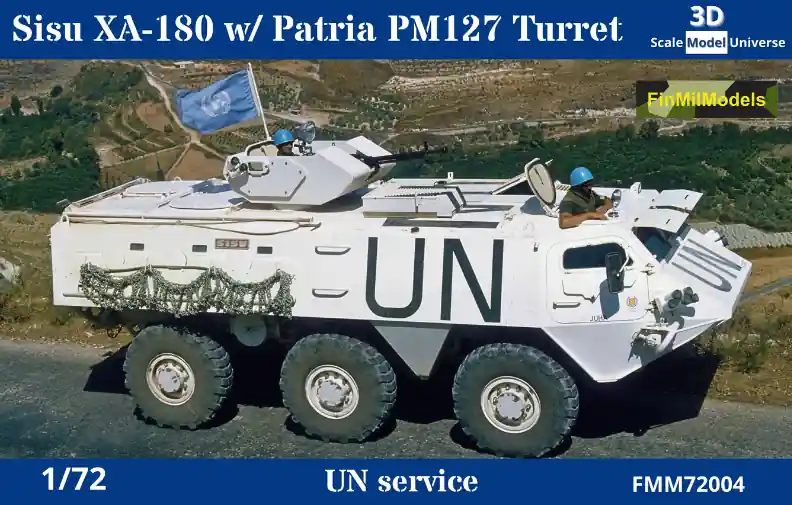
Patria Pasi (earlier known as the Sisu Pasi) is a Finnish-made six-wheeled armoured personnel carrier (APC) originally designed for Finnish Defence Forces. The first variant was produced in 1983, and serial production began in 1984. It was designed to operate with ease of use, simple structure and low-cost maintenance. The basic appearance and configuration of the Pasi is similar to most other wheeled APCs. The XA-180 and XA-185 are fully amphibious. December 1983, the Finnish Army ordered a first batch of fifty XA-180s. Nine were reserved for UN duties. The vehicle proved to be quite successful and more orders followed. Patria PM127 turret has been used on the Finnish XA-180 vehicle in several international operations.
The Sisu XA-180 is a Finnish-made wheeled armoured personnel carrier from the Cold War era and the present day. The first prototypes of the vehicle were built in 1982, and series production began shortly afterwards. The vehicle in its basic configuration is approximately 7.3 metres long, 2.9 metres wide and approximately 2.8 metres high. It is powered by a single Valmet 612 DWI diesel engine with 240 hp. Its fixed armament consists of a single 12.7 mm machine gun.
The Sisu XA-180 was developed primarily for the Finnish Army’s land forces as a classic example of a wheeled armoured personnel carrier. The vehicle provides protection primarily against small-calibre weapons fire and artillery shell fragments. It is worth noting that in order to reduce costs and accelerate research and development, components from the Sisu SA-150 truck were used on a relatively large scale. It is estimated that a total of approximately 1,200 Sisu XA-180 vehicles of all versions were produced in series. An interesting fact is that several units were used by the Polish Army as part of the UN mission in the Golan Heights.
Erreur de la ? Signaler le problème