Description
Informations de base
| Code de produit | MKM144035 |
| Poids: | 0.08 kg |
| Échelle | 1:144 |
| Ajouté au catalogue: | 21.8.2015 |
| Tags: | Bristol-Beaufighter |
| Fabricant | Mark I Models |
| Entité responsable |
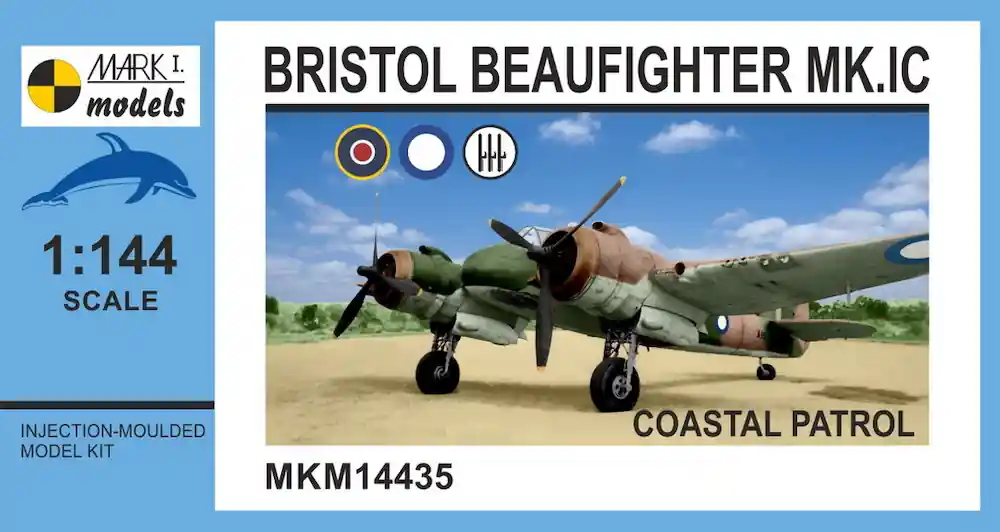
Bristol Beaufighter Mk.IC ‘Coastal Patrol’
The Bristol Beaufighter was a British heavy fighter, developed from the Beaufort torpedo bomber and its first prototype flew in July 1939. The first Beaufighter variants – the Mk.IF and Cs – were high performance fighters and long-range fighters, respectively, while the former Mark also became an efficient night-fighter, employing the then novel AI radar.
The Beaufighter was a two-seat, twin engine, all-metal mid-wing cantilever monoplane, fitted with a retractable undercarriage. It was powered by two Hercules radial engines and the armament consisted of four cannons in the nose, four guns in the starboard wing and another two guns in the port wing. The Beaufighter Mk.VIF, introduced in 1942, was fitted with more powerful engines and its wing mounted guns could be replaced by additional fuel tanks to extend the aircraft’s range.
Like its predecessors, the Mk.VIF was produced for Fighter Command and the Mk.VIC for Coastal Command. Some 1,840 Mk.VI aircraft were produced and this type remained in service until the summer of 1944.
The Beaufighter had a long career and served in almost all theatres of war during the WWII, at first as a night fighter, then as a fighter-bomber and eventually being used as a torpedo-bomber.
Colour schemes included in the kit:
1) Bristol Beaufighter Mk.VIF, X8023, Red BQ-I, No.600 Sq., RAF, Predannack airfield, summer 1942
2) Bristol Beaufighter Mk.VIC, T5273, Grey H ‘Benghazi Bus’, No.46 Sq., RAF, Idku airfield (LG-229), Egypt, December 1942
3) Bristol Beaufighter Mk.VIC, X8035, Sky J, No.227 Sq., RAF, Luqa airfield, Malta, August 1942
4) Bristol Beaufighter Mk.VIF, X8005, Red EW-R, No.307 (Polish) Sq., RAF, Exeter airfield, late 1942
This injection-moulded kit contains 53 parts and six clear parts (cockpit canopies, position lights etc.). A comprehensive instruction leaflet and a decal sheet are included.
Le Bristol Beaufighter est un chasseur de nuit bimoteur lourd britannique, un avion d’attaque et un avion torpilleur, avec une structure entièrement métallique à demi-coque. Il vola pour la première fois le 17 juin 1939 et sa production en série commença la même année. Pendant la guerre, de nombreuses versions du Beaufighter ont été créées, notamment Mk.I, Mk.II, TF Mk.X ou TF Mk.XI. La version Mk.I a été la première à fonctionner comme chasseur de nuit et était équipée de l’AI Mk. IV. Il disposait également d’un armement puissant : 4 canons de 20 mm et 6 mitrailleuses de 7,7 mm. Version Mk..X. était le dernier à être produit en grand nombre et combinait les avantages d’un avion de chasse avec la force de frappe d’un bombardier torpilleur. Cette version était propulsée par des moteurs Bristol Hercules XVII d’une capacité de 1770 CV. Les avions Bristol Beaufighter ont servi au total 53 escadrons de la RAF, 15 escadrons de la Royal Navy et l’escadron polonais 307 de Lwowskie Puchacze. Toutes les versions et tous les modèles de cet avion n’étaient pas faciles à piloter et souffraient beaucoup de vrilles et de problèmes causés par la panne d’un moteur. De plus, le Bristol Beaufighter avait un gouvernail très faible, ce qui entraînait une mauvaise stabilité directionnelle. C’est principalement pour ces raisons qu’à partir de 1943 ils furent successivement remplacés en première ligne par les DeHavilland Mosquito. Données techniques : Vitesse maximale : 512 km/h, vitesse de montée : 8,17 m/s, plafond maximal 5800 m, portée maximale : 2816 km, armement (version chasse) : fixe – 4 canons Hispano de 20 mm et 6 fusils mitrailleuses calibre 7.7 mm, suspendu jusqu’à 906 kg de bombes.Erreur de la ? Signaler le problème