Description
Informations de base
| Code de produit | DNM-48-827-050 |
| Poids: | 0.01 kg |
| Échelle | 1:48 |
| Ajouté au catalogue: | 27.5.2022 |
| Tags: | US-National-Insignia |
| Fabricant | DN Models |
| Entité responsable |
Allied Stars and Medical Crosses Paint Mask Stencils for Tanks and Soft Skin Vehicles WWII
Suggested Scale: 1:48
Re-usable die-cut camo mask set
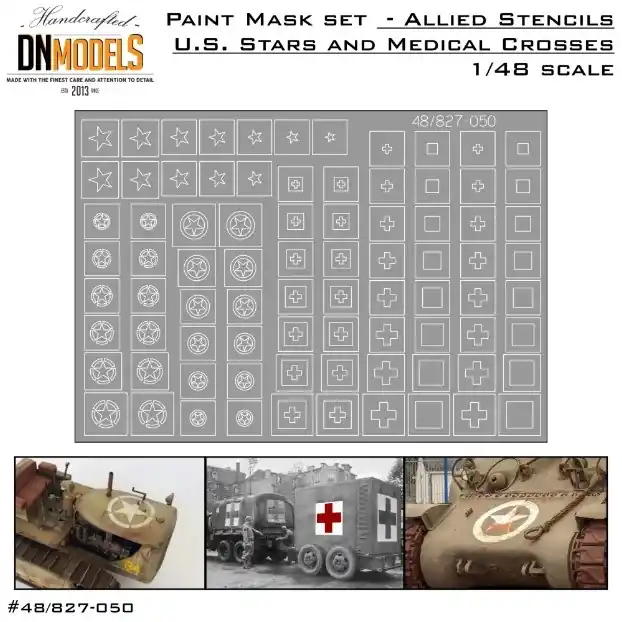
The set includes one sheet of pre-cut masks (shown in the picture). The masks are made from thin masking tape, which is easy to be peeled off and doesnt leave any stains. The tape is tested on clear and painted model too. If carefully removed after painting, they can be used over and over again. It is flexible and easily applied over curved surfaces. Semi-transparent for easy and accurate placing.
Suitable for various Allied Armored Vehicles from WWII. Features medical crosses. The set includes several sizes of stars and medical crosses which will cover most of the range in 48th scale. Some of the masks will cover 35th scale as well. Post-war vehicles are doable, including such from Korean war and even Vietnam.
Allied Stars and Medical Crosses stencils set in 35th scale is very popular among modelers. Due to the large number of requests for 48th scale option, the set 48/827-050 was designed. Of course, it was modified slightly from its original appearance. Allied Stars will suit Tamiyas 48th scale armor perfectly and will improve the appearance they offer. Tamiya decals are quite thick and in 48th scale that can cause troubles. Especially weathering-wise. Allied Stars set will come as a solution to that matter.
Allied Stars and Medical crosses
are suitable for all 48th scale armor, not only as Tamiya decals substitute. The painted star or cross will offer easy and realistic chipping, which cannot be achieved with a decal. However, some experience is needed and we suggest that you test them aside before you apply. Since the masks are re-usable, you will have no troubles repeating the procedure over and over again. Medical crosses are too, covering a wider range than just the quarter scale they are designed for. Many medical vehicles feature smaller crosses in the bigger /35th/ scale. In some cases, 72nd scale can use the smaller parts of this set to represent bigger for their appearance markings. These areof courseonly some of the options available.
In case you decide to use the set for 35th scale armor, we advise to check the size using reference materials first. Have in mind, that some vehicles, especially post-war US armor offer various sizes of white stars painted over them. Such vehicles are M113s and some of the soft-skinned options available. That will allow for wider range of applications of this set, thus you will be able to use it for more than one scale. However, we advise to use your best judgement in order to achieve maximum realism with your model.
Les marquages de nationalité (ci-après : insignes) sur les avions de l’US Air Force ont été utilisés pour la première fois en 1916, lors de la suppression de la soi-disant La rébellion de Pancho Villa au Mexique. Fait intéressant, ils n’ont montré qu’une étoile rouge – similaire à celles qui ont été utilisées plus tard sur les machines soviétiques. Cependant, dans la période de mai 1917 à février 1918, une étoile blanche a été utilisée comme insigne des avions américains dans un champ bleu circulaire avec un cercle rouge au centre. Cette désignation est revenue en 1919 et a été utilisée jusqu’en 1942. En mai de cette année, l’insigne a été modifié en supprimant le cercle rouge au centre, en raison de la possibilité de confusion avec les marquages des avions militaires japonais. Au cours de l’opération Torch, en novembre 1942, une jaquette jaune a été appliquée autour du champ bleu de l’étoile blanche. Cependant, à l’été 1943, l’étoile blanche dans le champ bleu a reçu des rubans blancs des deux côtés, et d’août 1943 à janvier 1947, des jaquettes bleues ont été ajoutées aux rubans. En janvier 1947, la désignation officielle des avions de l’USAF a été introduite, qui est en fait valable à ce jour (2019) – une étoile blanche sur fond bleu, avec deux rubans dans une jaquette bleue avec une seule bande rouge horizontale sur chaque ruban. Dans les années 1980, les insignes à faible visibilité ont été introduits, c’est-à-dire des insignes avec la disposition graphique de l’insigne mais peints avec une peinture uniforme blanche, noire ou grise.
Erreur de la ? Signaler le problème