Description
Informations de base
| Code de produit | SYH-AD007-72 |
| Poids: | 0.03 kg |
| Échelle | 1:72 |
| Ajouté au catalogue: | 8.3.2024 |
| Tags: | Breguet-Atlantic Dassault-Rafale GBU-12 Super-Etendard |
| Fabricant | Syhart Decal |
| Entité responsable |
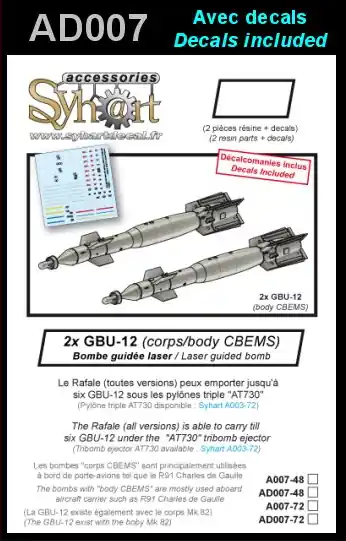
This kit consists of two 3D printed resin parts in very high resolution and an A6 instruction page for a pair of GBU-12.
GBU-12s are laser guided bombs 500lb class (250kg).
Used on:
- body Mk.82: Mirage 2000C/D/N, Rafale B/C, and others
- body CBEMS: Super-Etendard, Rafale M, Atlantique 2 (ATL2)
Able to strike static or moving targets with low hardness in good weather conditions. The bomb is guided to the designated target by a laser, « illuminated » by the plane dropping the bomb, or another plane, or even by troops on the ground.
The Rafale may be equiped by following laser designator pods :
- « Damoclès » Pod
- « Talios » (PDL NG) Pod
- « Sniper » AN/AAQ-33 Pod (export uniquement)
The Rafale (all versions) carry up to six GBU-12, installed under the AT730 triple pylons (available: Syhart A003)
« Body Mk.82 » or « body CBEMS » what is it?
The AASM 250, GBU-12 et GBU-49 exist in this two variants :
– The guided bombs are based on standard unguided bombs (the same as those used during the vietnam war) which a « guidance kit » has been added ; with tail, and guiding head (laser, optique, inertielle, GPS…) to make them extremely precise.
- So what are the differences between « corps Mk.82 » et « corps CBEMS » ?
The same guidance kit can be mounted on differents types of bombes, in most of case, the american standards bombs are used (Mk.82, 83 or 84, BLU-…), but these bombs do not meet the safety standards aboard aircraft carriers such as the Charles-de-Gaulle (R91).
- The CBEMS bombs (Secure Multiple Effects Bomb Body), were developed for this purpose, so they are mainly used by the Navy. They have a slightly shorter body than a Mk.82 with a cylindrical section, so the guide heads are a bit longer in order to keep the same aerodynamic characteristics.
Air force = body Mk.82
Navy = body CBEMS
(exceptions are always possible)
They have no printing irregularities, the fins are thin but strong. The parts are protected in a «cage» allowing transport and storage without breakage, including fins.
GBU-12 Paveway est une bombe aérienne américaine moderne à guidage laser. Ses premiers prototypes sont apparus dans la première moitié des années 1970, et il a été utilisé par les forces armées américaines en 1976 et y reste à ce jour. Le GBU-12 est capable de transporter des explosifs (Tritonal et PBNX) pesant jusqu’à 87 kg avec un poids total à vide de 230 kg.
Le GBU-12 Paveway a été développé et fabriqué par Raytheon et Lockheed Martin, basé sur le traditionnel Mk. 82 avec un poids de 227 kilogrammes. Modernisation du Mk. 82 consistait à ajouter une tête spéciale guidant le faisceau laser et des ailerons corrigeant la chute de la bombe. Le premier élément a été développé à l’origine par Texas Instruments, qui est devenu plus tard une partie de Raytheon. GBU-12 nécessite une mise en évidence avec un pointeur de cible laser. Deux générations de ces bombes sont apparues au cours de la production. Il représente le premier GBU-12 Pavé I , le second est le GBU-12 Paveway II. La différence – hormis la conception des ailerons – est avant tout que le Paveway II dispose d’un autodirecteur moins cher à produire et plus sensible, ce qui augmente sa précision et son efficacité. Le principal porteur de ces bombes est l’avion F-111. De plus, il peut être emporté par, entre autres : F-15 Strike Eagle, A-10 Thunderbolt II, F-16 Fighting Falcon ou F/A-18 Hornet. Au cours de l’opération Desert Storm en 1990-1991, des bombes Le GBU-12 Paveway a montré une efficacité de 88% pour atteindre les cibles.
Erreur de la ? Signaler le problème