Description
Informations de base
| Code de produit | RSM92270 |
| Poids: | 0.11 kg |
| Ean | 8594183912707 |
| Échelle | 1:72 |
| Ajouté au catalogue: | 13.6.2022 |
| Tags: | Bucker-Bu-133 |
| Fabricant | RS Models |
| Entité responsable |
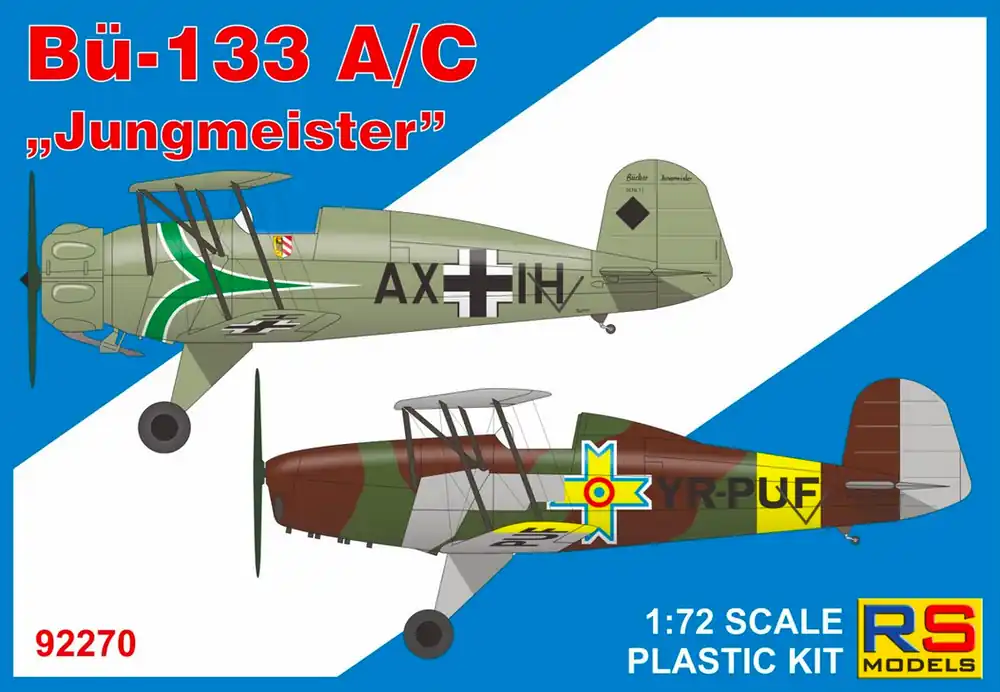
The Bücker Bü 133 Jungmeister was an advanced trainer of the Luftwaffe in the 1930s. It was a single-engine, single-seat biplane of wood and tubular steel construction and covered in fabric. The Bü 133 was a development of the Bücker Bü 131 Jungmann two-seat basic trainer.
5 decal variants:
1. Bü-133C, AX-IH, JG/54, Luftwaffe, 1942
2. Bü-133C, SP-BDG, airfield Mokotóv, Poland, 1938
3. Bü-133A, YR-PUF, Adaptarea, Bucharest, 1940
4. Bü-133C, Stab. IV/LLG 1, Kragujevac, Luftwaffe, 1941
5. Bü-133C, « Black 6 » of 1./JG 107, Luftwaffe, 1943
First flown in 1935 (by Luise Hoffmann, the first female works pilot in Germany), it was slightly smaller than the Bü 131. The prototype, D-EVEO, was powered by a 140 hp (104 kW) Hirth HM506 inverted, air-cooled inline-6 engine. The aircraft showed « astonishing agility » at its first public appearance, the 1936 International Aerobatic Championship at Rangsdorf, but the Bü 133A garnered no orders; only two Bü 133Bs, with 160 hp (119 kW) version of that same Hirth HM506 inline-6 engine, were built. The main production type was the 160 hp (119 kW) Siemens-Bramo Sh 14A radial powered Bü 133C, which had a distinctive cowling and a 13 cm (5.1 in)-shorter fuselage, and the same fine aerobatic performance as the Bü 133A.
Le Bucker Bu 133 était un biplan d’entraînement allemand monoplace avec un train d’atterrissage fixe de l’entre-deux-guerres et de la Seconde Guerre mondiale dans une conception mixte. L’entraînement était assuré – dans la version de base – par un seul moteur Hirth HM-6 de 135 CV. L’avion n’avait pas d’armes à bord.
Le Bucker Bu 133 a été développé comme un développement de l’avion biplace Bu 131. Comparé à son prédécesseur, le Bu 133 avait une cabine de pilotage pour une personne, un moteur plus puissant et était légèrement plus petit. Il a été utilisé comme machine d’entraînement avancée. Il avait également de très grandes possibilités dans le domaine de la voltige, qui ont été utilisées à grande échelle au cours du processus de formation. Au cours de la production en série en Allemagne, trois versions principales de cet avion ont été créées : Bu 131 A (version de base), Bu 131 B (seulement deux ont été construits) et Bu 131 C (propulsé par le Siemens Halske Sh.14A-4 moteur de 160 CV). . L’avion était également autorisé en Espagne et en Suisse.
Erreur de la ? Signaler le problème